NEW PROJECT!! Saltwater electrolysis using marine bacteria on titanium gas diffusion layers (SalYsAse)
in CAPTN Energy Consortium
![[Translate to English:] logo3](/fileadmin/content/forschen/fb2/mg/Geomicrobiology/SalYsase/Salysase_logo3.jpg)
![[Translate to English:] windturbines](/fileadmin/_processed_/e/7/csm_new_windturbines_a7932e6358.jpg)
Foto by Carolin Skottke
In the BMBF-funded CAPTN Energy joint project "Saltwater electrolysis using marine bacteria on titanium gas diffusion layers", new technological approaches will be applied using seawater directly as a source for the production of hydrogen (H2) by means of electrolysis and biocatalysts with improved efficiency. Saltwater electrolysis offers the possibility to convert the "clean" electricity generated at offshore wind turbines into the sustainable storage medium H2. Marine microbes will be used on porous gas diffusion layers to supplement or replace conventional catalyst layers. The aim is to establish marine microbial consortia that optimally support H2 production under the conditions prevalent in saltwater electrolysis. In this way, the overvoltage will be reduced, undesired side reactions suppressed and prior seawater purification no longer necessary. Therefore, the process of H2 generation from seawater can be carried out as environmentally friendly and cost-effective as possible. The project will be carried out in close cooperation with materials scientists from the Kiel University of Applied Sciences and Element22 GmbH.
![[Translate to English:] rb](/fileadmin/_processed_/2/1/csm_rb_11ad056634.jpg)
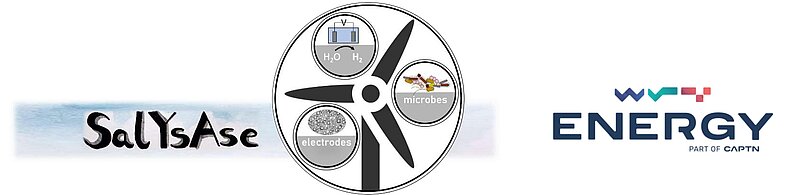
Saltwater electrolysis displayed in the overall context of energy generation from wind turbines and its path to the consumer. The SalYsAse joint project focuses on the saltwater electrolysis component in order to generate hydrogen. ArtWork © Rebecca Bährle
Outreach (selected)
NDR (Radio, 24.07.2025)
Tagesschau24 (TV online, 24.07.2025)
Renewable Now (25.07.2025)
Hydrogen Fuel News (25.07.2025)
VDI energie + Umwelt (31.07.2025)
Weser Kurier (newspaper, 23.08.2025)
Schleswig Holstein Magazin (TV, 24.09.2025)
SalYsAse-Team
Mirjam Perner (Coordinator, GEOMAR)
Nannan Zhao (postdoc, GEOMAR)
Jana Schloesser (FH Kiel, FuE FH Kiel GmbH)
Joanne Perkins (doctoral student, FH Kiel, FuE FH Kiel GmbH)
Florian Gerdts (element22)
Matthias Ernst (element22)