
The Impact of Microbes for Seafloor Massive Sulfide (SMS) Formation, Transformation and Dissolution
in the Priority Programme “Dynamics of Ore Metals Enrichment – DOME (SPP 2238)
![[Translate to English:] SMS](/fileadmin/_processed_/f/f/csm_Abb_1_3ac7397b6f.png)
Figure 1: A simplified schematic diagram visualizing chemical reactions of SMS weathering. (A) Oxygen-rich seawater influences chemical reactions on SMS. (B) Crust formation limits/restricts these reactions. Figure 1(A) is from Fallon et al. 2017. (C) A red Japis is shown as an example from the TAG hydrothermal field (provided by Dr. S. Petersen) (Murton et al.2019).
Seafloor massive sulfide (SMS) deposits form on the modern ocean floor and are analogues to ancient volcanogenic massive sulfide ore deposits that represent an important contribution to the global copper (Cu) and zinc (Zn) supplies. SMS deposits form at active high-temperature hydrothermal vent systems through mixing of mineral-rich, advecting hydrothermal fluids with bottom seawater. SMS deposits are mainly composed of pyrite (FeS2) and chalcopyrite (CuFeS2) and can be enriched in valuable metals such as Cu, Zn, cobalt (Co), gold (Au), and silver (Ag). Abiotic processes contribute to SMS transformation and dissolution but microbial activity considerably accelerates these reactions by catalyzing the precipitation of sulfide minerals, metal transport and mineral dissolution. Hereby the availability of oxygen is likely a key player for constraining the rate at which microbes contribute to transformation and dissolution of SMS deposits (figure 1). As yet, the kinetics of these microbially mediated processes have not been considered in model simulations on the transformation of SMS and the loss of valuable metals - after becoming hydrothermally inactive. One pressing issue is to understand the lifetime of ore deposits given that weathering processes modify the rocks’ compositions by converting primary into secondary minerals and releasing valuable metals as solutes depleting the economic value of the deposits over time. At current state the “ecosystem services” that microbes colonizing mineral deposits provide are not well understood (Orcutt et al 2020). Here we aim at a better understanding of the role that marine microbes have in the SMS transformation processes and thus durability of such deposits.
Fallon et al. (2017). Oxidative dissolution of hydrothermal mixed-sulphide ore: An assessment of current knowledge in relation to seafloor massive sulphide mining. Ore Geol Rev 86: 309-337.
Murton et al (2019). Geological fate of seafloor massive sulphides at the TAG hydrothermal field (Mid-Atlantic Ridge). Ore Geol Rev 107: 903-925.
Orcutt et al (2020). Impacts of deep-sea mining on microbial ecosystem services. Limnol Oceanogr 65: 1489-1510.
The main questions that will be addressed in this project include:
Question 1: What are the kinetics of microbial vs. abiotic SMS weathering?
Question 2: How protective are silica caps against microbial oxidative weathering of SMS?
Question 3: What is the impact of microbial oxidative weathering on the loss of metals (e.g. Cu, Zn, Co)?
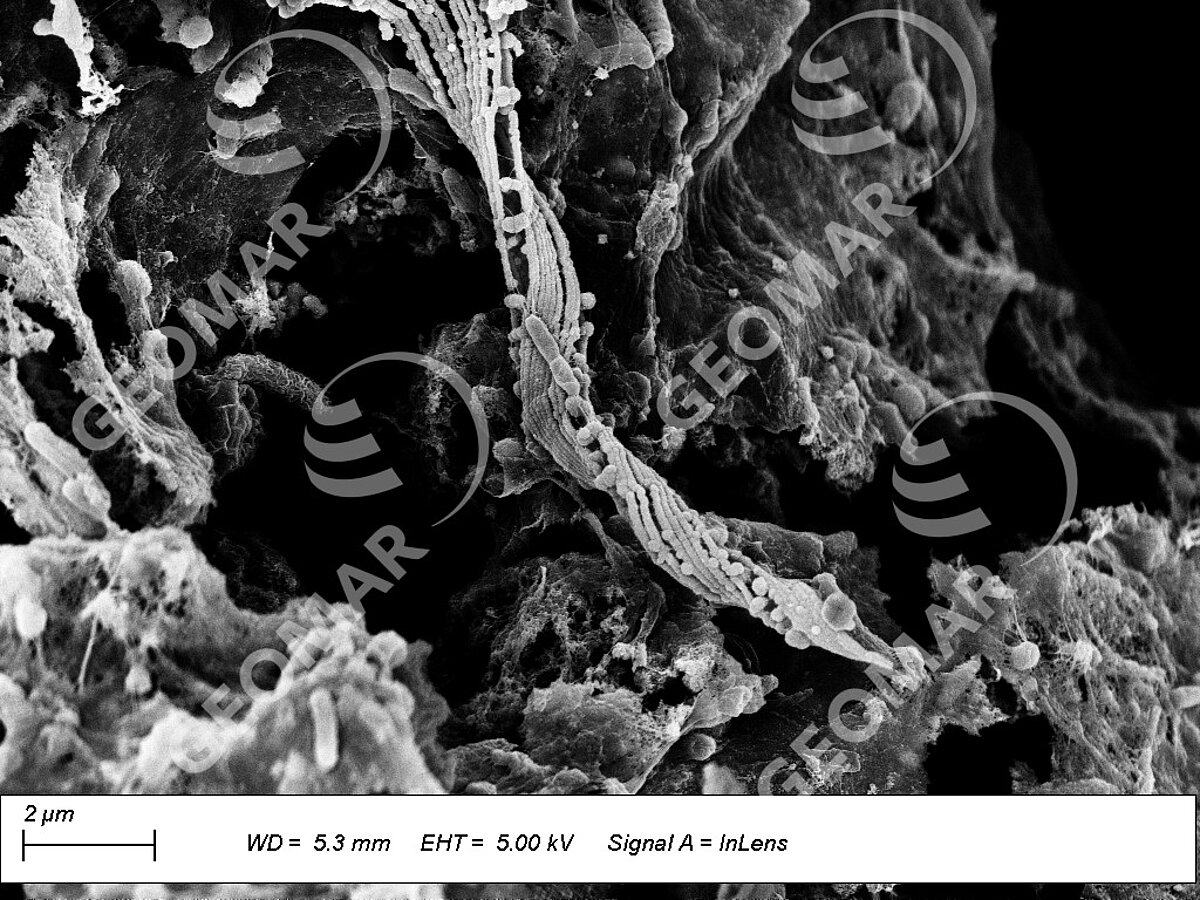
Scanning electron microscopy (SEM) image of pyrite samples after 4 year in situ incubation. Image showing various microbes and a twisted stalk formed by iron oxidizing bacteria is observed. Photo credits: © C. Solterbeck, Institute for Materials and Surfaces, University of Applied Sciences Kiel
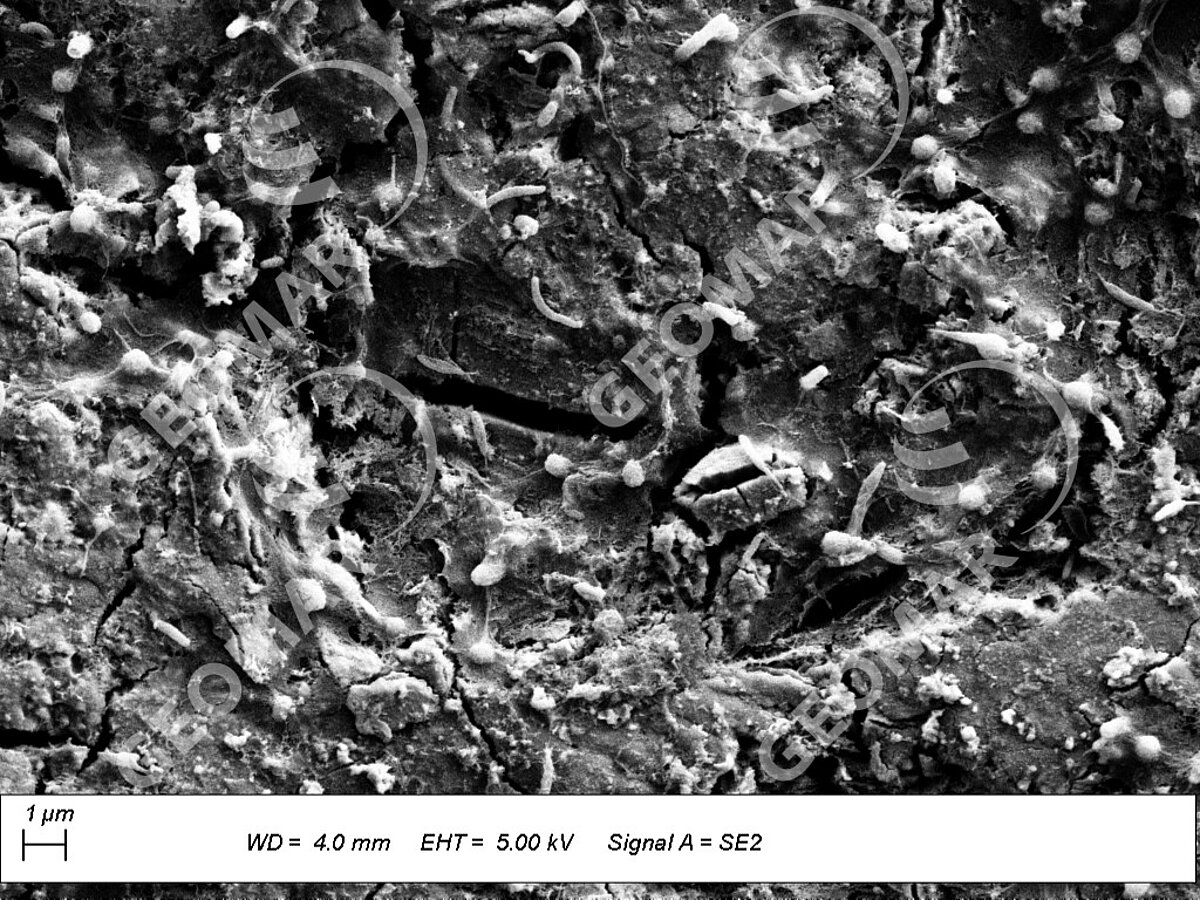
Scanning electron microscopy (SEM) image of pyrite samples after 4 year in situ incubation. Image showing various microbes colonizing on a pyrite sample. Photo credits: © C. Solterbeck, Institute for Materials and Surfaces, University of Applied Sciences Kiel
In this project we incubated pyrite and SMS for four years at the seafloor (INDEX2019, BGR) and collected fresh hydrothermal material during one cruise to the Indian Ridge (INDEX2023, BGR) and one cruise to the Red Sea vent areas (HEXPLORES). To understand to what degree and under which conditions the microbes accelerate weathering processes of SMS deposits we will combine microscopy, minerology, geochemistry and microbial tools.
More information on...
4-year in situ experiments with pyrite and chalcopyrite
laboratory enrichment cultures with SMS
This Project is embedded in the Priority Programme “Dynamics of Ore Metals Enrichment – DOME (SPP 2238)
Team of MineralMicrobe:
Geomicrobiology
Prof Mirjam Perner (Lead-PI)
Ola aka Alexandra Tecza-Wiezel (PhD student in the project)
Dr. Katja Laufer-Meiser (GEOMAR)
Mineralogy
Dr. Sebastian Fuchs (BGR)
Dr. Sven Petersen (GEOMAR)
Geochemistry/Marine Mineral Resources
Prof. Dr. Sylvia Sander (GEOMAR) Co-PI
Microscopy
Prof. Dr. Ing. Jana Schloesser (FH Kiel)
Dipl. Phys. Claus-Henning Solterbeck (FH Kiel)
Cruises
INDEX2019 chief scientist Dr. Ulrich Schwarz-Schampera
INDEX 2023 chief scientist Dr. Thomas Kuhn
HEXPLORES chief scientist Dr. Nico Augustin
Presentations
Tecza-Wiezel A., K. Laufer-Meiser, C.-H. Solterbeck, J. Schloesser, S. Sander, M. Perner (2025)
New Insights into SMS Deposits: How Microbial Activity and Oxygen Levels Shape Metal Preservation (EGU General Assembly 2025), April 29, 2025
Tecza-Wiezel A., K. Laufer-Meiser, C.-H. Solterbeck, J. Schloesser, S. Sander, M. Perner (2025)
New Insights into SMS Deposits: How Microbial Activity and Oxygen Levels Shape Metal Preservation (DOME - General Assembly 2025), April 1, 2025
Tecza-Wiezel A., K. Laufer-Meiser, C.-H. Solterbeck, J. Schloesser, S. Sander, M. Perner (2024) Insights from a four year in-situ incubation experiment at the Indian Ridge: How Microbes Impact Seafloor Massive Sulfide Weathering. Vereinigung für Allgemeine Mikrobiologie Jahrestreffen (VAAM) Würzburg, Germany, June 2-5,2024
Tecza-Wiezel A., K. Laufer-Meiser, C.-H. Solterbeck, J. Schloesser, S. Sander, M. Perner (2024)
The Impact of Microbes for Seafloor Massive Sulfide Formation, Transformation and Dissolution (BGR - Symposium), Hannover, Germany June 6, 2024
Tecza-Wiezel A., K. Laufer-Meiser, C.-H. Solterbeck, J. Schloesser, S. Sander, M. Perner (2024)
Insights from a four year in-situ incubation experiment at the Indian Ridge: How microbes impact seafloor massive sulfide weathering (D-A-CH-Geobiology - Symposium), Bayreuth, Germany September 30, 2024
Outreach
https://www.biographic.com/life-finds-a-way-even-on-inactive-hydrothermal-vents/